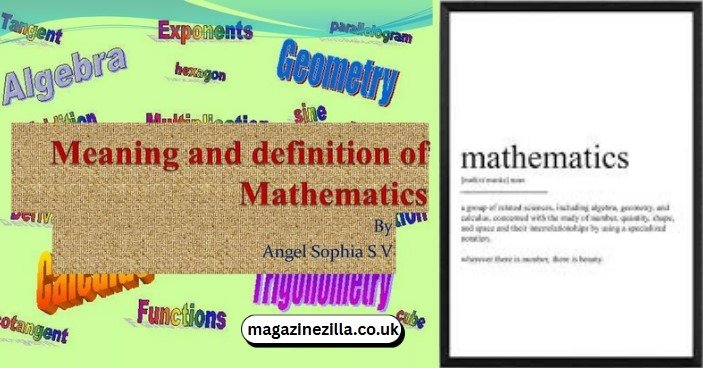
Mathematics is a language of logic, precision, and clarity. Every concept, theorem, or formula in math is built upon a foundation of definitions. Understanding the meaning of definition in math is essential for anyone aiming to excel in mathematics, whether in academics, research, or real-world applications. Definitions provide a precise way to describe mathematical objects, relationships, and operations, ensuring consistency and accuracy across the entire field. Without definitions, mathematics would lack the structure and rigor required to communicate complex ideas effectively.
The meaning of definition in math extends beyond memorizing phrases. It encompasses understanding why a term is defined in a particular way, how it interacts with other concepts, and how it forms the groundwork for proofs, problem-solving, and advanced mathematical thinking. This article explores the meaning, significance, and practical application of definitions in mathematics while providing examples to illustrate their essential role.
What is the Meaning of Definition in Math?
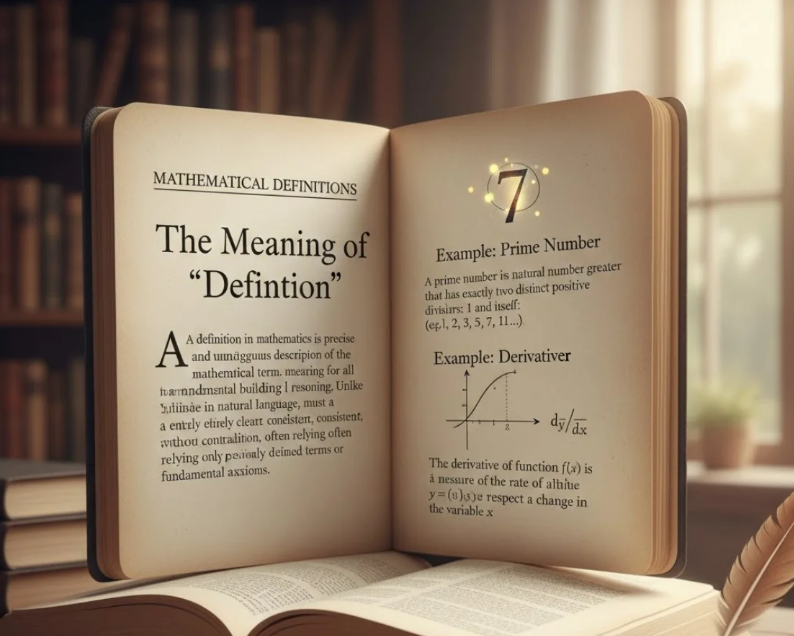
In the simplest terms, a definition in mathematics is a precise statement that explains the meaning of a mathematical term or concept. Unlike general language, where meanings can be flexible, mathematical definitions are exact and unambiguous. They serve as the building blocks for reasoning, ensuring that all mathematicians and students interpret concepts consistently.
Mathematical definitions specify the properties and conditions that an object must satisfy. For example, the definition of a prime number is “a natural number greater than one that has no positive divisors other than one and itself.” This definition is concise, precise, and universally accepted. It allows anyone to identify prime numbers without confusion, making mathematical reasoning reliable and systematic.
In essence, understanding the meaning of definition in math is about grasping the essence of a concept, knowing the criteria it meets, and recognizing its implications in mathematical structures. Definitions are not arbitrary; they are carefully formulated to capture essential characteristics while excluding irrelevant features.
People can read this: AI Image Enhancer Software: Transforming Digital Images with Intelligent Technology
Importance of Definitions in Mathematics
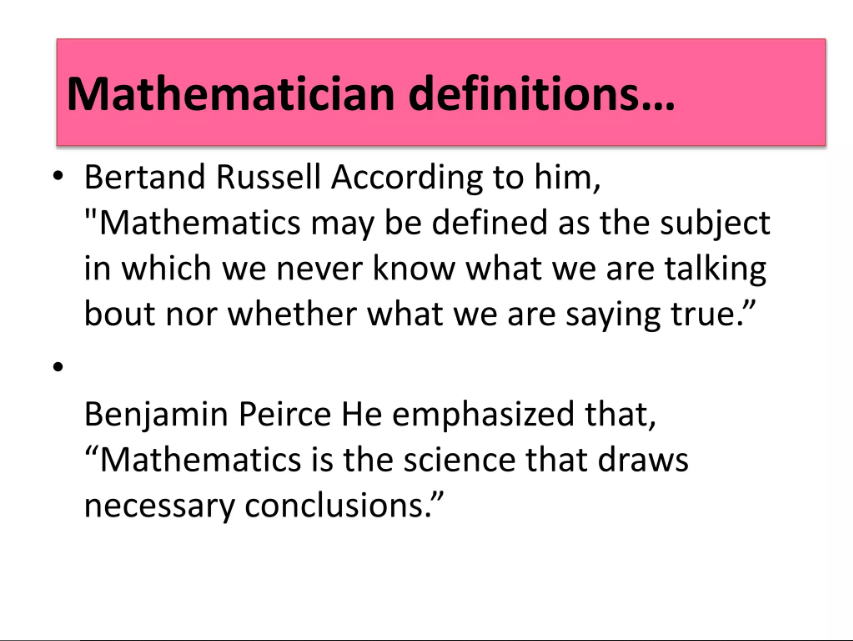
Mathematical definitions are more than just formalities. They are the backbone of reasoning and problem-solving. The importance of definitions in mathematics can be understood in several ways.
First, definitions ensure clarity and precision. In mathematics, vague or inconsistent usage of terms can lead to incorrect conclusions. By clearly stating what a concept is, definitions eliminate ambiguity and make it possible to develop proofs and logical arguments.
Second, definitions provide a foundation for proofs and theorems. Every mathematical proof relies on well-defined terms. For instance, understanding the definition of a function is critical before exploring concepts like continuity, differentiability, or integrability. Without a clear definition, constructing valid proofs would be impossible.
Third, definitions enhance communication among mathematicians. When definitions are standardized, scholars and students worldwide can share ideas, collaborate, and verify results without misunderstanding. Mathematics, as a universal language, depends on definitions to maintain consistency and universality.
Finally, definitions aid in cognitive development. Learning precise definitions helps students develop critical thinking, analytical skills, and the ability to categorize and generalize concepts. These skills are valuable not only in mathematics but also in problem-solving across various disciplines.
Types of Mathematical Definitions
Mathematical definitions can be categorized in different ways based on their purpose and usage. Recognizing these types helps in understanding the meaning of definition in math more comprehensively.
One common type is the explicit definition, which directly states the meaning of a term. For example, “A rectangle is a quadrilateral with four right angles.” This definition explicitly identifies the essential properties of a rectangle.
Another type is the implicit definition, which defines a concept through its relationships with other mathematical objects. For instance, the concept of a limit in calculus is often defined implicitly using inequalities and other mathematical operations, rather than a simple sentence.
Stipulative definitions are used to introduce new terms or concepts for convenience. In advanced mathematics, scholars often define new structures or objects to simplify discussion or to explore new areas of study.
Operational definitions describe a concept based on the procedure used to measure or construct it. For example, the absolute value of a number can be defined as the distance of that number from zero on a number line.
Understanding these types clarifies how definitions in mathematics are not merely descriptive but functional, guiding reasoning, computation, and proof construction.
People can read this: Epstein File: Unveiling Jeffrey Epstein’s Ties to the Scientific Community
Examples Illustrating the Meaning of Definition in Math
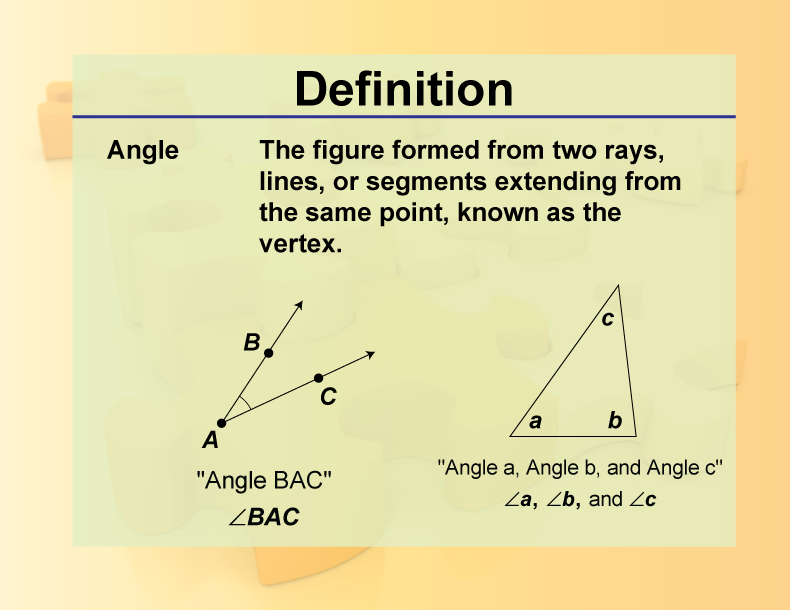
Examples are vital in illustrating the meaning of definition in math, helping learners connect abstract concepts with concrete understanding.
Consider the definition of an even number: “A number divisible by 2 without a remainder.” This definition sets a clear criterion. Any number satisfying this property, like 4 or 18, is even, while numbers like 7 or 13 are not.
Another example is the definition of a circle: “The set of all points in a plane that are at a fixed distance from a given point called the center.” This definition not only identifies what a circle is but also implies properties such as radius, circumference, and symmetry.
In algebra, the definition of a function as “a relation between two sets where each element in the first set is associated with exactly one element in the second set” establishes the basis for understanding graphs, derivatives, and integrals. Without such a definition, these higher-level concepts would lack rigor and clarity.
Through examples, it becomes evident that definitions are not just abstract statements but tools that enable understanding, computation, and application in mathematics.
Role of Definitions in Advanced Mathematics
As students progress, the meaning of definition in math becomes even more crucial. In fields such as calculus, linear algebra, abstract algebra, and topology, definitions are the key to unlocking complex ideas.
In calculus, the definition of a limit provides the foundation for derivatives and integrals. Understanding the formal epsilon-delta definition allows students to rigorously prove results, avoiding misconceptions that may arise from intuitive explanations.
In linear algebra, definitions of vectors, matrices, and linear transformations are essential for constructing proofs and solving problems involving vector spaces. Without precise definitions, concepts like eigenvalues or determinants would lack meaning.
Abstract algebra relies heavily on definitions of groups, rings, and fields. These definitions are highly abstract but provide a framework for exploring algebraic structures systematically. The precision in definitions allows mathematicians to discover relationships between different algebraic systems and prove universal properties.
Through these examples, it is clear that definitions are not just introductory elements but foundational pillars supporting all branches of mathematics.
People can read this: 404.594.9134: Everything You Need to Know About This Number
Common Misconceptions About Definitions in Math

Despite their importance, many learners misunderstand the meaning of definition in math. One common misconception is that definitions are arbitrary or only for memorization. In reality, definitions are carefully crafted for logical consistency and must satisfy essential properties to be valid.
Another misconception is that definitions are unchanging. While core definitions remain stable, mathematics is dynamic, and new definitions are introduced to address new problems, extend concepts, or simplify reasoning. For example, the concept of infinity has evolved over centuries, and definitions have been refined in set theory and calculus.
Some students also confuse examples with definitions. While examples illustrate a concept, they are not definitions themselves. For instance, saying “4, 6, and 8 are even numbers” is not a definition; it merely illustrates what the definition entails.
By understanding these misconceptions, learners can approach definitions with clarity and confidence, improving both comprehension and application in mathematics.
Practical Applications of Definitions in Math
The significance of understanding the meaning of definition in math extends beyond the classroom. Definitions play a crucial role in real-world problem-solving, engineering, computer science, and scientific research.
In engineering, precise definitions of physical quantities like force, voltage, or pressure are necessary for designing systems that are safe and efficient. Without well-defined mathematical models, calculations and simulations could lead to errors.
In computer science, definitions underpin algorithms and data structures. Defining a data type, a function, or a computational process clearly ensures that software behaves predictably and efficiently.
In research, definitions allow scientists to formulate hypotheses, design experiments, and interpret results consistently. Mathematical modeling in physics, chemistry, and economics relies on precise definitions to produce meaningful conclusions.
Understanding definitions also enhances problem-solving skills. By analyzing the properties specified in a definition, learners can approach problems systematically, identify relevant strategies, and avoid incorrect assumptions.
People can read this: AI Tools for Students Free: Best Artificial Intelligence Tools to Study Smarter in 2025
The Link Between Definitions and Mathematical Proofs
One cannot overstate the connection between definitions and mathematical proofs. Proofs rely entirely on well-defined terms to establish truth logically. Without clear definitions, proofs would collapse under ambiguity.
For instance, proving that the sum of two even numbers is even requires the definition of an even number. By expressing even numbers as multiples of two, mathematicians can rigorously demonstrate the property, ensuring the argument is valid for all even numbers.
Similarly, in geometry, theorems about triangles, circles, or polygons depend on precise definitions of shapes, angles, and lengths. The logical structure of proofs builds directly on these foundational definitions.
Thus, mastering the meaning of definition in math is not merely academic; it is central to developing the reasoning and analytical skills that define mathematical thinking.
Enhancing Learning Through Definitions
To fully grasp mathematics, students should engage actively with definitions. This involves more than memorization. It requires analyzing, questioning, and applying definitions to solve problems.
One effective strategy is to rewrite definitions in one’s own words, then test them with examples and counterexamples. This process ensures that the learner internalizes the essential characteristics of each concept.
Another approach is to explore connections between definitions. For example, understanding the link between prime numbers, factors, and divisibility rules can deepen comprehension and improve problem-solving efficiency.
By interacting with definitions in a meaningful way, learners move from rote memorization to genuine understanding, enhancing both confidence and mathematical intuition.
Conclusion
The meaning of definition in math is far more than a formal statement or a memorized sentence. Definitions are the building blocks of mathematical reasoning, the foundation of proofs, and the key to understanding complex concepts. They provide clarity, consistency, and a universal language for mathematicians worldwide.
By appreciating the purpose and application of definitions, students and professionals can enhance their problem-solving skills, think critically, and approach mathematics with both rigor and creativity. Whether in academic study, research, or real-world applications, mastering definitions is essential for success.
FAQs
What is a definition in mathematics?
A definition in mathematics is a precise statement explaining the meaning of a term or concept, specifying its essential properties.
Why are definitions important in math?
Definitions ensure clarity, consistency, and accuracy. They form the foundation for proofs, problem-solving, and effective communication.
How do definitions help in learning advanced math?
Definitions provide the basis for understanding complex structures, formulating proofs, and connecting related concepts in higher-level mathematics.
Can definitions in math change over time?
Yes, while core concepts remain stable, new definitions can emerge to address new problems, simplify reasoning, or extend existing concepts.
How can students better understand mathematical definitions?
Students can rephrase definitions in their own words, apply them in examples and counterexamples, and explore connections with related concepts.
For more updates visit: FUSION GLANCE